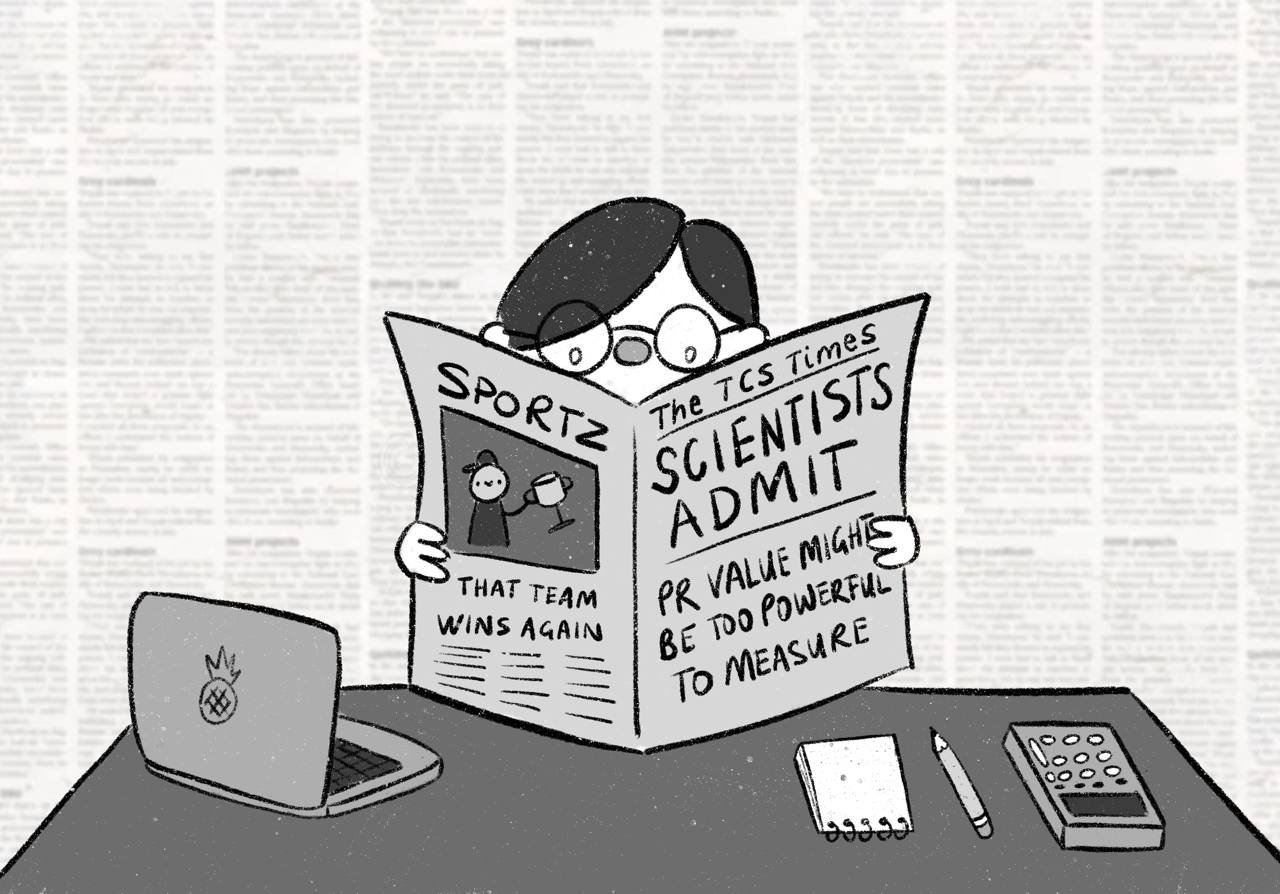
The Cost of the Missing Piece
Sharp heels clicked down the corridor. You could feel the fury in the rhythm before she even entered the room.
I kept my eyes glued to my screen, trying not to look, but dying to know what was happening.
Then, a loud slam on the island table.
“Why did we miss this clipping?”
“Who read the newspaper this morning?”
“Bring out the paper.”
She wasn’t yelling at anyone in particular. But it felt like she was yelling at everyone.
“Why wasn’t this sent to the client?”
“All news coverage should be sent to clients by 10 am!”
Almost instinctively, the account manager stepped forward. One clipping had been missed. Just one. And yet, it felt like everything was on fire.
At my first PR agency, one of the earliest lessons I learned was that every piece of coverage matters.
Inside the Logic of PR Value
No one really explained why it mattered so much. Back then, you didn’t question anything; you just did as you were told. I made sure not to miss anything for fear of being called out.
Over time, that caution turned into habit. I got good at what seemed like a simple task - tracking coverage across print and online media, knowing not just how and where to look, but also when to check, ensuring nothing slipped through and everything was updated in a timely manner. Then came the next step: turning that into PR value, proving our work was worth something.
My Account Director was often asked by clients in meetings: “What does PR value really mean? Why do you multiply by 3?”
The answer was almost always: “It’s the industry standard.”
I stayed quiet. But it left me questioning what the “industry standard” actually meant. If missing that clipping could cause such a stir, why wasn’t its value clearly justified?
The First Time I “Saw” PR Value
I started to think about what ‘good PR” could actually look like.. If being a great PR person meant delivering high PR value for clients, I wanted that to be my standard.
At one point, I set a KPI for myself - get my client into all Tier 1 media. And I did. I remember working on a PR-driven campaign about iron deficiency in pregnancy - articles went out; coverage looked great. But the real moment came when the client started receiving calls. People weren’t just reading. They were responding. Asking. Acting.
For the first time, I saw the impact of news coverage. I began to see PR as something that could change lives and help people. When used strategically, it could create real connections with audiences.
However, in my first agency, PR was largely practised in a conventional way, with coverage as the main benchmark of success. There wasn’t much room for me to explore beyond that.
When Success on Paper Stopped Feeling Like Success
A lot of people see reporting as mundane - the kind of work that should be left to juniors. But it was through reporting that I learned how to “get more PR value” for my client.
I learned what the media liked. I learned what got picked up. I learned how to shape a story that could land Tier 1 coverage, drive big numbers, and deliver impressive reach. And just as importantly, I learned how to justify it.
PR value is three times the ad value because earned media is more credible.
It helps justify budgets.
It helps unlock more investments.
These were the narratives I learned to make sense of the work - to convince not just clients, but myself. So yes, I knew how to make campaigns look successful on paper.
But the more I started to understand the system, the more I started to question it.
Because deep down, I knew PR could do more than this.
I just didn’t feel like I could break the mould - not in an agency world where the same templates had been used for decades.
Until one conversation changed everything.
The Shift
I was presenting a CSR proposal to the Communications Lead of External Affairs at P&G. I was ready with the usual PR angle, reach, coverage, and PR value.
He stopped me. “Don’t tell me the PR ROI first.”
Then he asked: “Are you proposing something that the beneficiaries truly need?”
No one had ever asked me that before. It wasn’t a question about numbers or coverage but about relevance. We had always focused on whether the media would pick up the story, not what happened after.
“Find that out,” he said. “Build your campaign around that.”
Going Beyond PR Value
I spoke with caretakers and spent time understanding their day-to-day challenges. I rebuilt the campaign around their needs, supporting children with special needs in a way that actually made sense to them.
We still aimed for headlines, but the dynamic had shifted. There were small but powerful interactions - a child reaching out for a hug, a swim coach feeling proud of the student he didn’t give up on, children lighting up with joy as they spent time with national athletes, and caretakers beginning to ask for more collaborative work going forward.
Of course, HQ still wanted publicity from the CSR effort. The expectations did not disappear. But the team lead drew a clear boundary - we were not going to turn the children into props for brand storytelling. That experience became a turning point. It changed how I approached projects, and how I understood PR value itself.
I’m grateful to the team lead for giving us space to do PR without compromising the human side of it and defaulting to templates and in that moment, it affirmed what I had been sensing all along: there really was more to PR than what we usually measured.
What We Like About PR Value
PR value isn’t useless.
We like it because it’s:
Easy to calculate
Easy to report
Easy to compare
And not every client has the luxury of running deep research, tracking long-term perception, or measuring behavioural change.
Sometimes, you just need a simple way to show that PR is working. PR value does that.
The problem begins when it becomes the only thing we look at.
Why PR Value Doesn’t Work Like It Used To
Today, PR value is becoming harder to justify.
It made sense in a time when the media was limited, controlled, and trusted.
However, that landscape has shifted.
Content is everywhere and with attention getting more fragmented than ever, news is often missed or unread.
At the same time, the lines between earned, owned, and paid media have blurred. Press releases can be distributed widely for a fee. Coverage can be amplified, sponsored, or repackaged. Not everything that looks like “earned media” carries the same weight anymore.
And when everything is measurable in reach and impressions, the question becomes: Does being seen mean being remembered?
PR value still measures visibility. But in today’s fragmented media environment, where anyone can be a media, being seen doesn’t guarantee attention, trust, or action. Relying on it alone risks mistaking visibility for true effectiveness.
There Is No One Definition of Success
Despite its limitations, PR value remains a default for many. In a world full of pressure from management and clients, and the fear of failure, marketers often stick to what feels safe: what has worked before and what can be easily proven.
Here’s the catch: communication isn’t like baking. There’s no fixed recipe. What worked before might not work now. What works for one client might fail for another. And yet, so many campaigns fall into the same trap. They chase the same metric, without asking if it’s the right one.
How We See PR Value Today
Today, if I’m being honest, I’d probably tell clients to drop PR value altogether — we spend so much time putting it together, and half the time it’s just for show. When that’s not possible, we start our projects with a different question: what actually matters to our clients and consumers?
Because success looks different for everyone.
For a concert, coverage means nothing if ticket sales don’t move
For an SME, one meaningful story may matter more than a million ringgit worth of PR value
For a listed company, a single article can influence market perception and share price
For a brand in a competitive field, a consistent narrative shapes how people see you
Same tools. Same industry. Different definitions of PR value.
What Are You Really Chasing?
The industry will always chase numbers. That won’t change anytime soon. But maybe the better question to ask is: Are you measuring what matters?