Fighting for Yourself in the Attention Economy
I’ve been thinking about attention lately.
More specifically, I have been thinking about how we decide what things are worthy of our attention. Brands everywhere are banging on and on about staying relevant in the attention economy. Business models are built around how to snag and grab eyeballs, how to maximise our screen time, all as if we are difficult to convince and aren’t constantly just giving it away for free.
Take a look around! Think about your own habits. What is your first instinct when you get to your lunch appointment a few minutes early? Where do your eyes go when you pull up at a traffic light? What is that one thing you grab before you head to the bathroom? And why is the answer always your phone?
It’s so rare to see a person just sitting there and looking at the world around them. We’re all addicted to looking at our phones. It’s something constant, no, compulsive, and it’s these gajillion dollar companies who are investing their vast resources to keep us hooked. But the same ol’ same ol’ can only keep its shine for so long. And then what? What do you do when the new and exciting starts to lose its lustre?
That’s easy: you escalate.
The algorithm starts feeding us headlines and clips more shocking and extreme than the last. The news has to be titillating, it has to grab you by the collar and scream in your face. It has to make you feel something and if that emotion is fear or anger, that’s even better! Fear and anger keeps us hooked. We stay longer. We scroll more. Because if we stay, maybe – just maybe – we will come across a funny video and that’ll make the whole endeavour worth it.
You probably already know all of this. You might know it intellectually, having noticed it yourself or perhaps it’s just something you can feel in your bones after a long session of doomscrolling in a less-than-ideal sitting position. And despite the knowing, the sting in our eyes, and the aches in our thumbs and pinky fingers, when we have that little moment of quiet, we will still reach for our phones.
In 2014, researchers conducted a study on boredom. Participants could choose to sit quietly in an empty room for 15 minutes or entertain themselves by pressing a button that delivered an unpleasant electric shock to their ankles. A quarter of the women and two thirds of the men chose to press the button. If this experiment were repeated today, in our digital age of short-form content and AI-generated slop, I’d be genuinely surprised if any of the participants could sit through the 15 minutes without electrocuting themselves at least once.
And like a sudden and powerful jolt of electricity, the endless scroll is not good for us. Bombarding our brains with horrific news, divisive opinions, and aggressive advertisements is a very steep price to pay for a mildly entertaining video every handful of swipes. It wreaks havoc on our nervous systems. It makes us fear one another. So why does it still feel like a little treat that we ‘get’ to do at the end of the day before we slip into unconsciousness?
Social apps like TikTok, Instagram, and Facebook trigger reward-seeking behaviour – dangling delicious hits of dopamine in front of us and luring us into the doomscroll trap. There is a buzz of anticipation that accompanies opening up a social app and our monkey brains can find that very difficult to ignore, especially when we’re feeling tired and burned out.
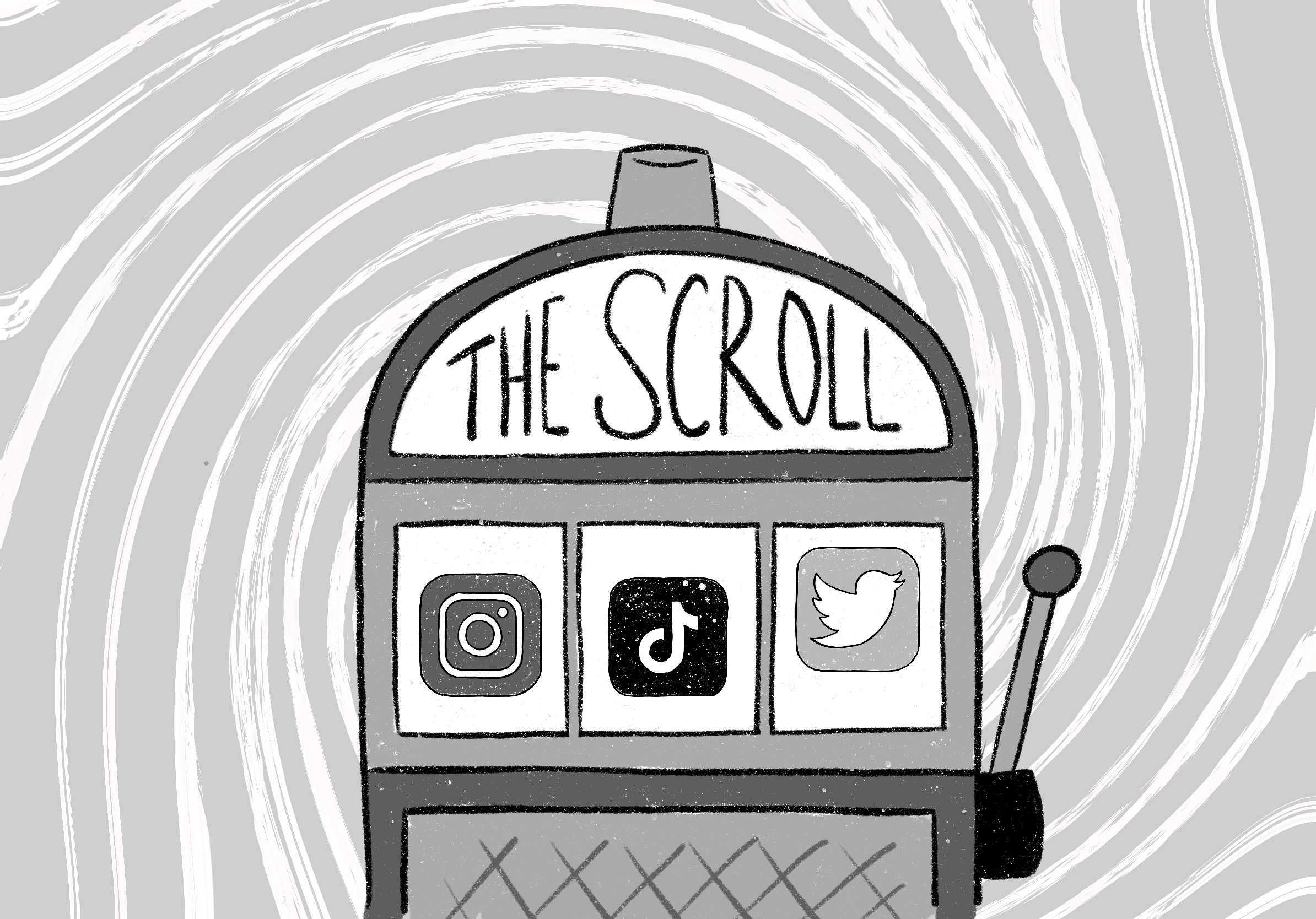
This conversation would be different if a scrolling session could make us feel better. If a 15-minute scroll could ease our worries and leave us feeling refreshed and ready to tackle our next big task, there would be no problem of which to speak. But time spent like that on my phone almost always leaves me feeling more drained and empty than before. Most of the time, I regret giving away my time like that. It’s eerily similar to dropping token after token into a slot machine and pulling the lever an uncountable number of times before you realise the game is rigged or find that your bucket is empty.
And the game is rigged.
The apps in your phone are designed to be as inviting and irresistible as possible. The short-form content and switching between apps give you the impression you’re not spending as much time as you are on your device. You don’t need to actually make a decision about what you want to see. Sitting down with a book or an episode of TV doesn’t actually take more energy than looking at your phone does, but I think we’d all agree that the phone feels like the easier choice.
But if it is true that we’re Pavlov’s-dog-training ourselves to pick up our phones at the first hint of boredom, it must also be true that the reverse is possible.
The first thing I did to get my phone screen time down was to set time limits on social apps. Those were my biggest time sinks and the apps I used most mindlessly. The next thing I did was to change my phone’s display to greyscale (super recommend this – it makes your phone horrible to look at). Most recently, I turned on downtime to lock me out of almost every app when I’m supposed to be winding down for bed and until after I’m done getting ready in the morning; those are the times of day at which I am the sleepiest and the easiest to hook.
Your smartphone is a tool. You are the one who chooses how it works for you. I no longer want to surrender my attention to the next thing Big Tech is trying to sell me. Perhaps you want to consider that too.